
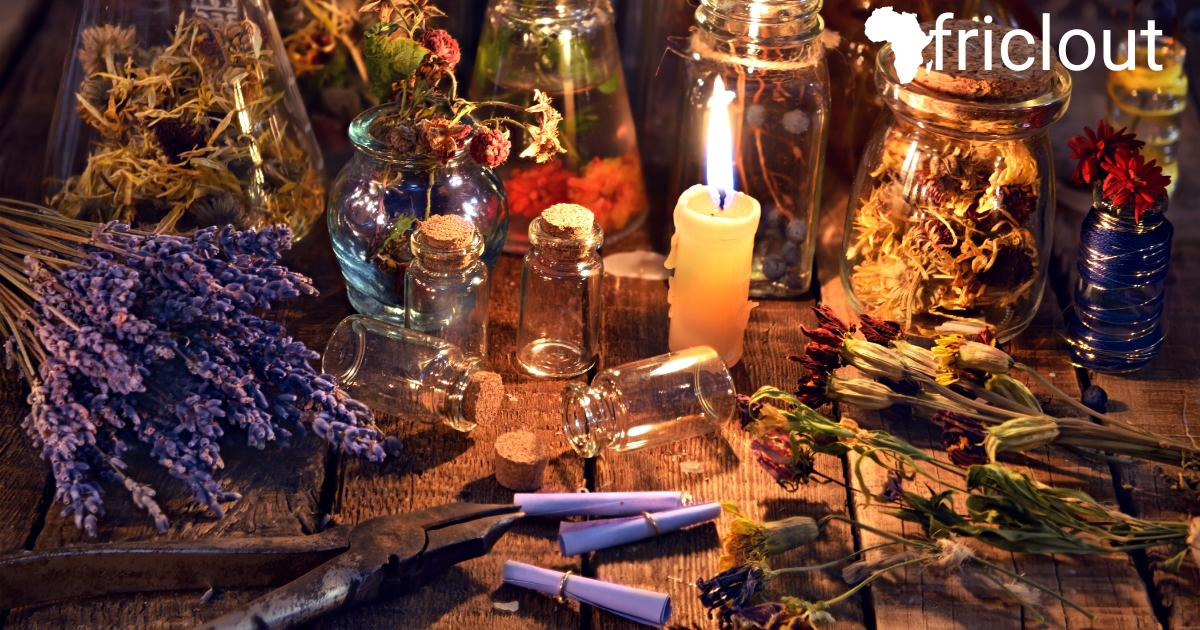
The old woman’s eyes held centuries.
As she ground herbs between her palms, the mortar and pestle sang an ancient rhythm that pulsed through the red earth beneath our feet. My mother had dragged me there—desperate, defiant—after months of Western medicine had failed to touch whatever darkness was eating away at my father’s spirit.
“She’s a witch,” whispered the neighbors.
“She’s a healer,” my mother whispered back.
In that moment, I understood something that has shaped my thinking ever since: the difference between witch and healer might simply be a matter of who gets to tell the story.
Power, Misnamed and Misunderstood
Across Africa, women who possess knowledge of plants, spirits, and the invisible threads that bind our world together exist in a liminal space—respected and feared, revered and reviled. They’re sought out in moments of crisis and shunned in moments of calm. This contradiction isn’t accidental. It is the calculated outcome of centuries of efforts—colonial, religious, and patriarchal—to sever African women from their spiritual, medicinal, and social power.
The woman who can read the future in spilled water, who knows which roots calm a restless mind or bring down a fever, is not a threat. But her power is—and that power has always made the world uneasy.
The Language of Erasure
Let’s be clear: when African women healers are called “witches,” it is not just misnaming—it is a linguistic assault. The term is loaded with the weight of European paranoia, Christian mission work, and patriarchal suspicion. It strips away cultural nuance and replaces it with accusation.
The women I grew up with—the ones who whispered over infants, brewed tinctures from bark and memory, communed with unseen forces—were not malevolent. They were keepers of knowledge that predates libraries and medical schools. Walking archives of botanical science, intuitive psychology, and spiritual diplomacy.
Yet when that power is feared, misunderstood, or threatens the status quo, it is recast as something dark. The same spiritual practices now earning research grants in Western labs and feeding global wellness trends were once—and often still are—grounds for accusation and exile.
When Colonization Named the Witch
The figure of the African witch—the purely evil, destructive woman—was largely invented. In many traditional societies, spiritual power was viewed as morally neutral, its intent determined by the user. There were checks and balances, ethics, and elders to regulate practitioners. Harmful acts were punished; healing was celebrated.
But colonialism disrupted these systems, severing generational transmission of cultural understanding. In their place: fear. Suspicion. Fragmentation. Christianity’s dualism (heaven vs. hell, God vs. Satan) merged disastrously with the complexities of African spiritual life. Women who once held revered positions as diviners, midwives, and custodians of oral knowledge were now branded as witches.
This colonial logic didn’t even require direct persecution. It introduced just enough instability for communities to turn against their own. Every misfortune needed a scapegoat—and often, it was the woman who refused to stay small.
Healers in the Crossfire
Today, African women practicing traditional medicine or spiritual work must navigate a landscape fraught with contradiction. In major cities, you’ll find them tucked between beauty salons and mobile money kiosks—unlicensed, uncelebrated, but always busy. Their clients come at night, hush-hush, and leave in the same silence.
Some healers adapt. They rebrand as “natural wellness consultants,” acquire certificates, hang framed photos of their graduation from short herbalism courses. They know the game: legitimacy requires speaking the language of science and business, even if the knowledge was passed down in a dream.
Others refuse the performance entirely. They throw bones. They enter trance. They speak of ancestors and spirits without shame. They hold firm to traditions too potent to repackage.
Regardless of approach, their status is always provisional. If they succeed, they’re praised. If they fail—or if someone in their orbit suffers misfortune—they can quickly become suspect.
The Algorithmic Witch Hunt
In the digital age, power comes with visibility. And visibility, as always, is double-edged.
Social media has created new audiences for African spiritual practitioners. On TikTok and Instagram, women share rituals, plant wisdom, and ancestral practices. Some find global followers and financial freedom. Others find themselves targets of online mobs, branded as witches in comment sections and WhatsApp forwards.
The irony is sharp. The same women preserving ancient oral traditions must now navigate platforms designed to erase nuance. One misunderstood post, one misinterpreted ritual, and their entire lives can be reduced to a viral accusation.
To survive, many have learned to code-switch: they offer “energy work” instead of spirit work, “intuitive sessions” instead of divination, “herbal blends” instead of ancestral medicine. This rebranding allows them to operate, but it comes at a cost—part of their story must always be hidden, softened, or mistranslated for public comfort.
Reclaiming Ancestral Power
And yet, resistance blooms.
A new generation of African women is refusing to dilute or disguise their practices. They’re not asking for permission or legitimacy. They are claiming space—as healers, diviners, midwives, dreamers, and guardians of forgotten knowledge.
They are writing books, forming collectives, archiving rituals, and mentoring apprentices. They’re not just keeping traditions alive—they’re making them future-proof. Some start podcasts. Others build e-commerce platforms to sell ethically sourced herbs. Some conduct healing rituals via Zoom. Their practice is rooted, but it is not static.
They are also organizing. From Kenya to Ghana, women-led healer associations are pushing for legal recognition, ethical codes of practice, and protections from violence. They are building networks where spiritual work is treated not as superstition, but as intellectual and cultural labor worthy of dignity and safety.
These women know the stakes. They know that when spiritual knowledge dies, it is not just a loss of ritual—but a loss of worldview, memory, and medicine.
The Politics of Naming
The woman who treated my father never called herself a witch, nor a healer. She didn’t call herself anything at all.
She didn’t need the vocabulary of academia or the validation of institutions. She knew what she knew. That was enough.
And maybe that’s the real threat. Women who are rooted in something older than empire, older than profit, older than the need to explain themselves—are hard to control.
Which is why so many systems try to name them into submission.
But the tide is turning. African women are re-authoring their narratives, rejecting labels that erase, flatten, or demonize. They are showing us that the question has never been whether they are witches or healers—it’s whether we are willing to reckon with the power they carry and the mirror they hold up to our collective spiritual disconnection.
A Final Reflection
In a world that profits from our disconnection—from land, from spirit, from community—these women offer something terrifyingly radical: remembrance.
They remind us of a time when healing wasn’t transactional, when medicine grew from the ground outside your hut, when illness had meaning and not just symptoms. They remind us that wisdom can live in a woman who never went to school. That power can be gentle. That the sacred does not require a cathedral.
The real question, then, is not who they are.
It’s who we are—without them.
Do you know a woman whose wisdom defies labels? Share her story in the comments below.
 Africlout